
Engineering Problem Solving
Process Reliability & Automation of an Internal Coating System
How can an unstable legacy deposition platform be transformed into a reliable, programmable system for controlled internal coating?
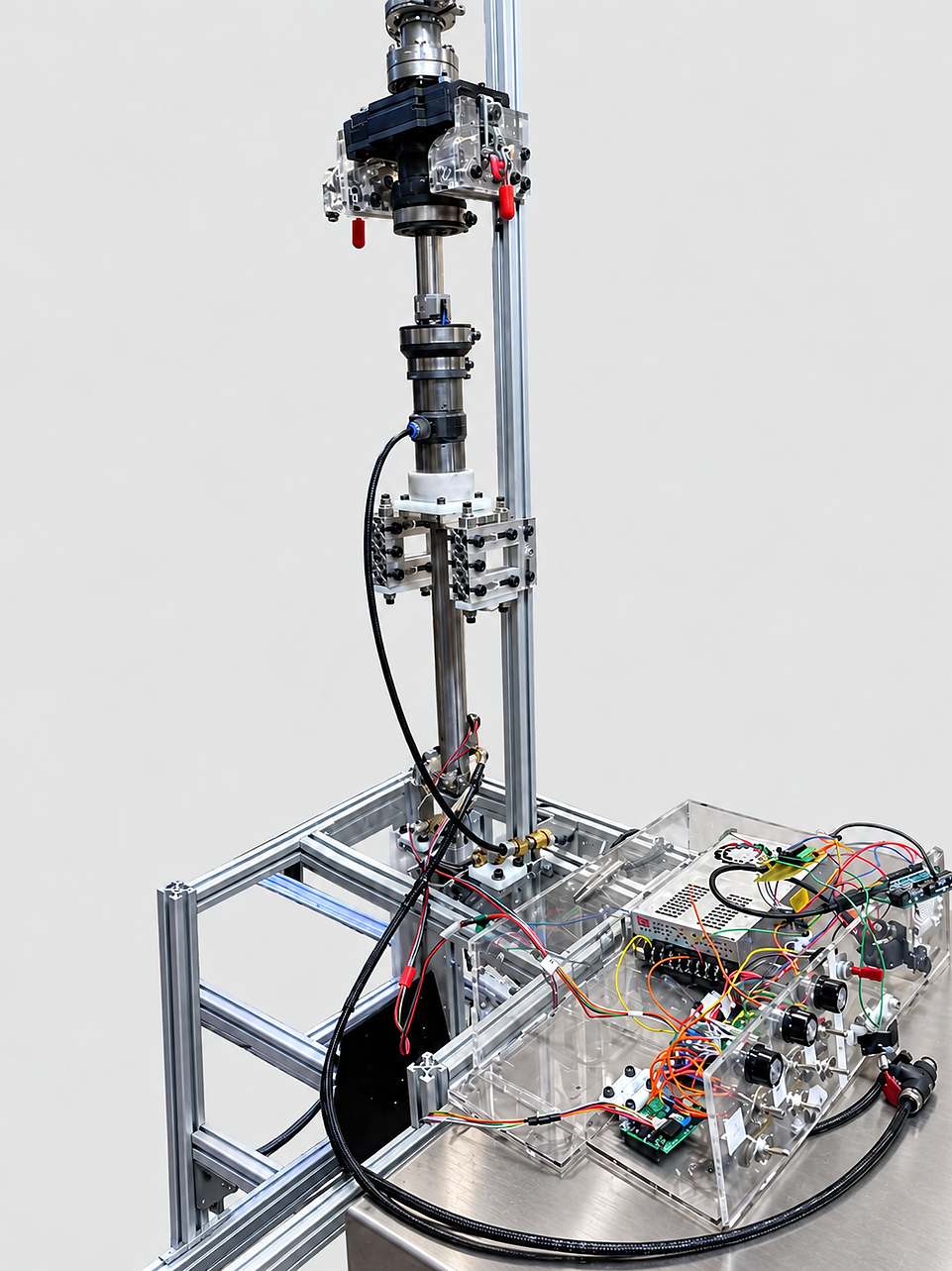
A legacy aerosol-deposition platform was being used to deposit ceramic coatings on the internal surfaces of tubular substrates. Although the basic system was functional, repeated mechanical and control-related failures limited coating consistency, process repeatability, and experimental flexibility.
Rather than replacing the platform, the system was evaluated as a complete process to identify the sources of instability and redesign only the components that were limiting deposition performance.
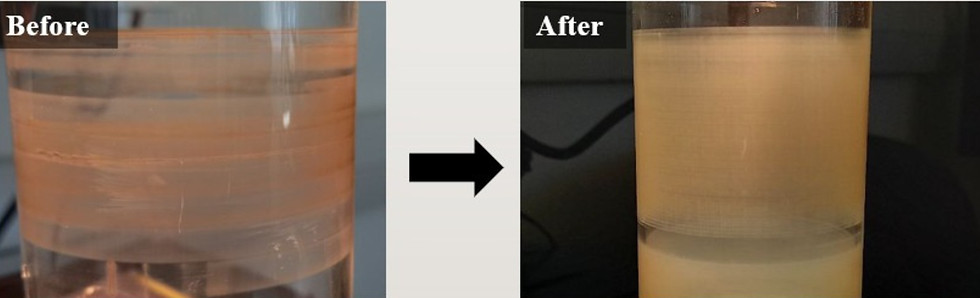
Before

After
Identifying the Failure Modes
Initial troubleshooting showed that the deposition problem did not originate from a single component. Several interacting issues were affecting system reliability:
-
Vibration from the powder-feeding system was transferred into the supporting structure.
-
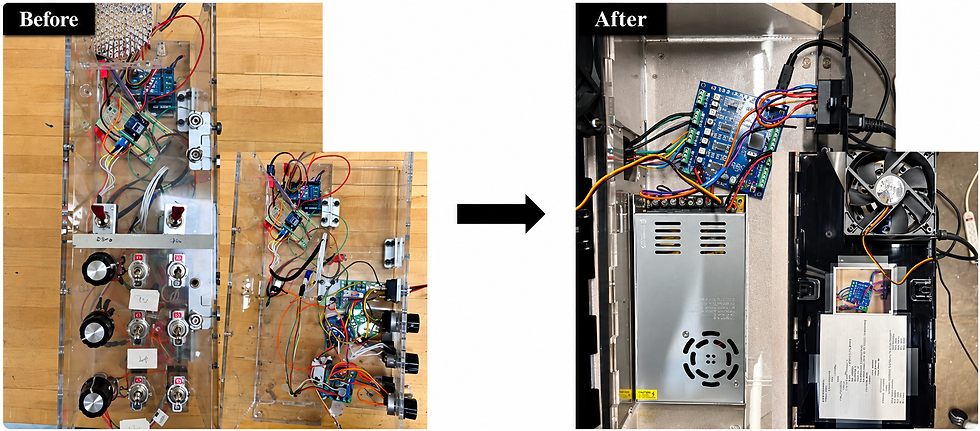
The control system relied on multiple manual switches and extensive wiring.
-
Cables associated with the rotating nozzle assembly repeatedly became entangled during operation.
-
Vertical translation was not sufficiently synchronized for smooth coating trajectories.
-
The original layout provided limited space for the aerosol generator and associated process hardware.
Together, these issues affected nozzle positioning, motion stability, coating coverage, and experimental repeatability.
From Manual Operation to Programmable Motion
One of the first changes was the replacement of the fragmented manual control architecture with a centralized TinyG motion-control system.
This allowed nozzle rotation and vertical translation to be controlled programmatically rather than through independent manual switches. The redesigned control architecture also reduced wiring congestion and enabled the deposition trajectory itself to become a controllable process parameter.
Most importantly, synchronized motion made it possible to generate continuous helical coating paths inside the tube, improving control over coating coverage along both the axial and circumferential directions.
Eliminating a Recurring Nozzle-Positioning Failure
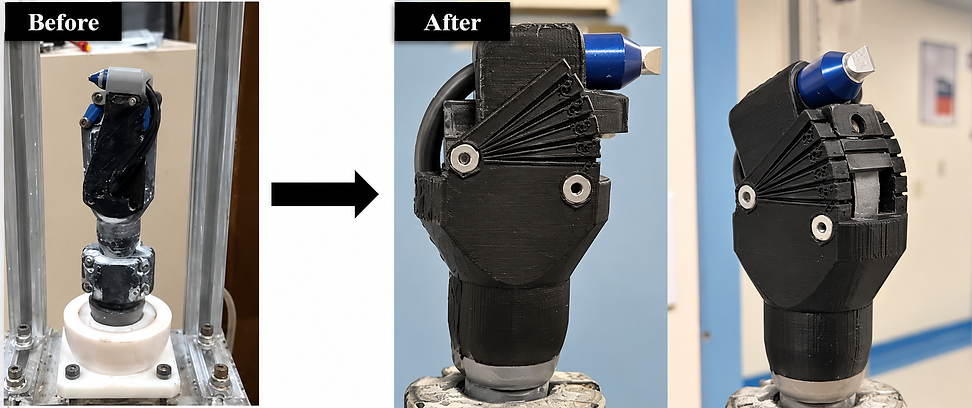
The original nozzle-positioning mechanism relied on electrically actuated components located close to the rotating assembly. During operation, the associated cables could wrap around the rotating spindle, producing intermittent failures and eventually damaging the positioning motors.
Instead of replacing the failed actuator with another similar component, the failure mode itself was removed.
A new mechanically indexed, adjustable-angle nozzle holder was developed that could maintain the required nozzle orientation without electrical wiring in the rotating section. This simplified the mechanism and eliminated cable entanglement as a recurring source of system failure.
Stabilizing Vertical Motion
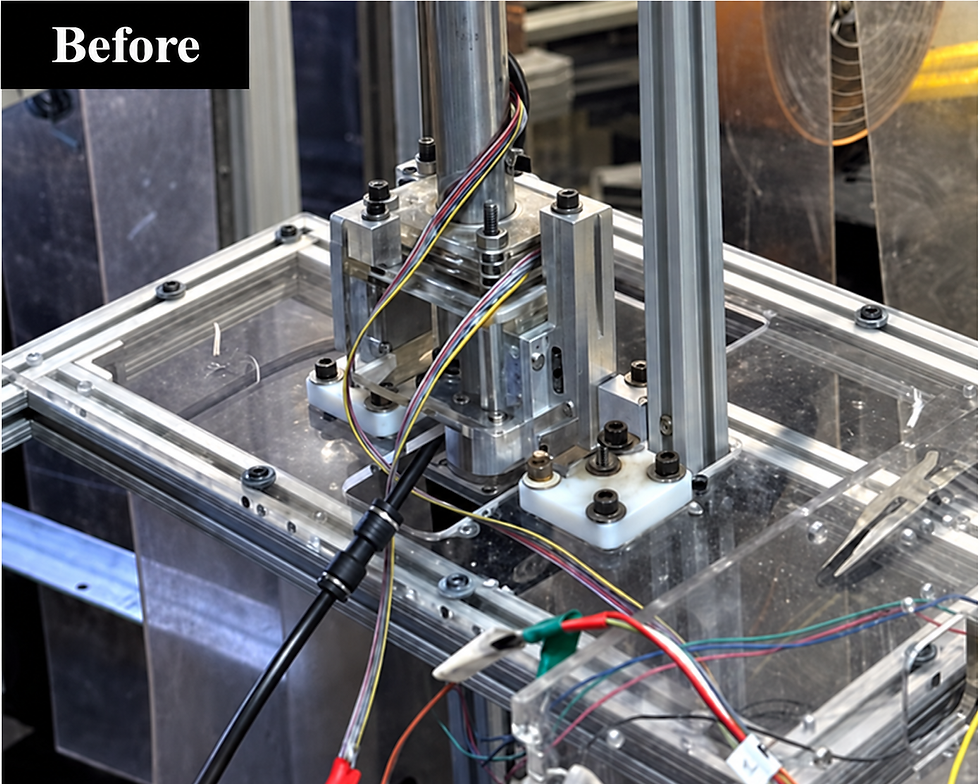
The original system used a single drive for vertical translation, which produced uneven movement and reduced control over the nozzle path.
The redesigned system incorporated dual synchronized drives on opposite sides of the moving structure, improving support and producing smoother vertical translation.
More stable Z-axis motion was particularly important because vertical displacement and nozzle rotation must remain coordinated to maintain a consistent helical deposition trajectory along the tube
The nozzle-rotation drive was also upgraded to provide more stable operation under the combined effects of vibration and gas flow.
At the same time, a dedicated mounting location was incorporated for vacuum-pressure monitoring, making an important deposition parameter directly visible during operation and improving control of the experimental process.
These modifications were treated as part of the same system-level redesign: motion, pressure conditions, powder feeding, and nozzle position all influence the conditions under which particles are delivered to the substrate.

From Machine Reliability to Coating Reliability
The purpose of the redesign was not simply to make the equipment operate more smoothly. The objective was to create a deposition platform capable of producing controlled and repeatable internal coating trajectories.
After the redesign:
-
nozzle rotation could proceed without cable interference,
-
vertical translation became smoother and synchronized,
-
continuous helical deposition paths could be programmed,
-
process monitoring became more accessible, and
-
coating coverage along the tube became more consistent.
The rebuilt platform therefore provided a more reliable experimental foundation for subsequent studies of powder behavior, deposition parameters, coating uniformity, and material performance.
Engineering Approach
Observe the failure → Identify the root cause → Remove the failure mode → Integrate the solution → Validate through deposition
This project combined root-cause analysis, experimental-system redesign, motion control, automation, and materials-processing validation to convert an unreliable legacy platform into a programmable research tool for internal aerosol deposition.