
Aluminosilicate Coating for Erosion Protection of Steel Pipelines by Dry Aerosol Deposition Method
This research focuses on the deposition of aluminosilicate ceramic coatings on steel substrates to improve surface durability and resistance to harsh service environments. The work explores how dry aerosol deposition can be used to form protective ceramic layers and how substrate properties influence coating adhesion and mechanical performance.
1- Why This Research Matter?
Steel components used in demanding environments are often exposed to wear, surface degradation, and corrosive conditions. Improving the surface performance of these materials is essential for extending service life and reducing maintenance costs. This project investigates ceramic surface protection as a pathway to enhance the durability of steel substrates while maintaining a scalable engineering approach.
Dry Aerosol Deposition Apparatus

2- Why Dry Aerosol Deposition?
2- Why Dry Aerosol Deposition ?
Dry Aerosol Deposition enables ceramic coatings to be consolidated directly at room temperature through high-velocity particle impact, eliminating the need for conventional high-temperature sintering.
This low-thermal-budget approach can reduce processing complexity and potentially lower manufacturing cost, making it particularly attractive for coating temperature-sensitive or large engineering components. In this research, DAD is being explored as a scalable route for aluminosilicate protection of steel surfaces, with future application to internal pipe geometries used in oil and gas environments.
3- How the Method Works
In this process, dry ceramic powder is aerosolized and carried by gas flow through the deposition system. The particles are accelerated toward the target substrate, where repeated impact contributes to coating build-up. The resulting layer is then evaluated in terms of adhesion, hardness, and substrate-dependent behavior.
5- Materials and Substrates
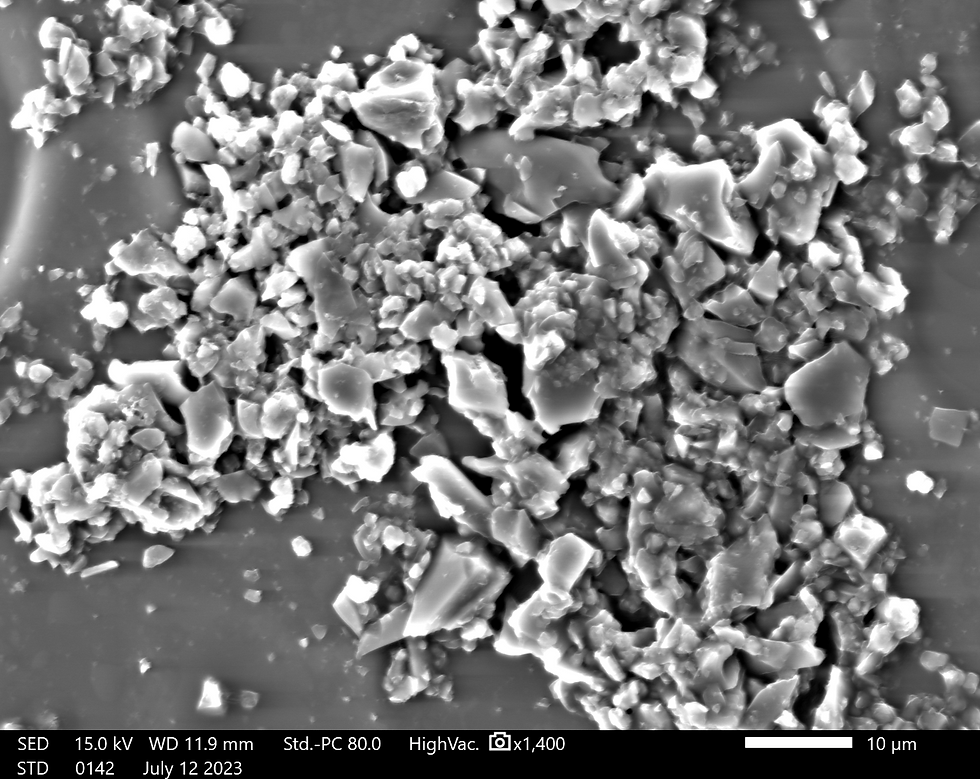
Scanning electron microscopy (SEM) micrographs of as-received powder
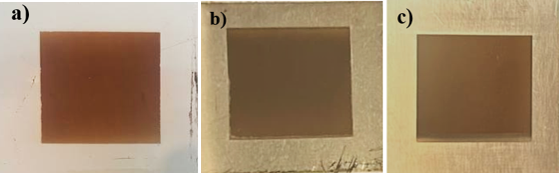
Optical images of coated Substrates with coated area of 15×15 mm deposited on a) Glass b) Steel c) Aluminum
4- Research Objective
The primary objective of this work was to investigate the deposition of aluminosilicate coatings on steel substrates and evaluate how substrate type influences coating quality and mechanical behavior. Particular attention was given to coating adhesion and hardness, with the goal of understanding how substrate-dependent response affects the integrity of the deposited ceramic layer.
6- Characterization
Surface and Cross-Section Morphology
SEM images show dense aluminosilicate coatings formed on glass, stainless steel, and aluminum. The cross-sections confirm continuous film formation, while the surface morphology reflects the impact-driven fragmentation and compaction characteristic of DAD.

Formation of the Anchor Layer
The first deposition pass produced distinctly different anchor-layer morphologies on each substrate. Steel showed fine embedded particles and flake-like features, while aluminum developed a thicker, more nodular layer with more visible defects, highlighting the role of substrate response during the earliest stage of coating formation.

Surface and Cross-Section Morphology
SEM images show dense aluminosilicate coatings formed on glass, stainless steel, and aluminum. The cross-sections confirm continuous film formation, while the surface morphology reflects the impact-driven fragmentation and compaction characteristic of DAD.
7- Crystallinity and Phase Composition
Before evaluating coating performance, XRD was used to determine how high-velocity particle impact altered the aluminosilicate structure during deposition. Understanding these structural changes is important because impact-induced fragmentation and amorphization can influence the resulting mechanical behavior of the coating. The deposited film showed a substantial reduction in crystallinity compared with the feedstock, indicating significant impact-driven amorphization during DAD.

8- Nano-Mechanical Properties
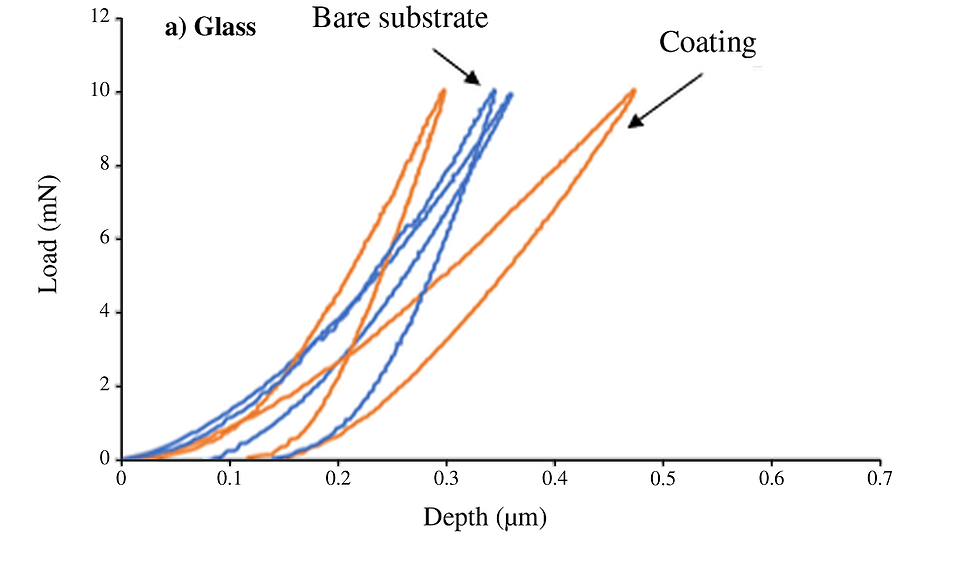
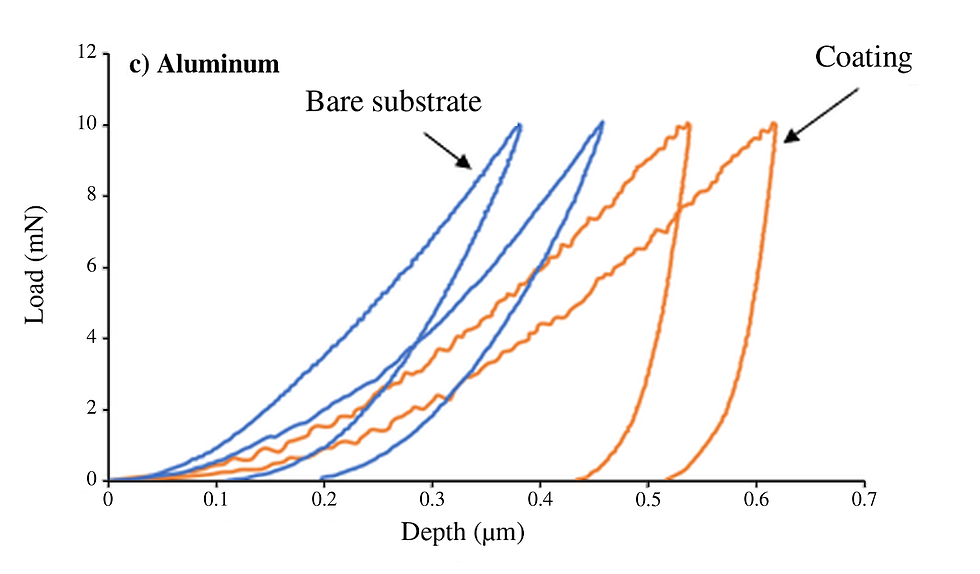
For a coating intended to resist erosion and mechanical surface damage, hardness is an important performance parameter. Nanoindentation was therefore used to evaluate how effectively the deposited ceramic layer increased surface hardness and how the substrate influenced the final coating response.
The DAD coating increased the hardness of both metallic substrates, with the highest coating hardness of approximately 5.9 GPa measured on stainless steel.


9- Adhesion Test
Pull-off testing showed strong bonding between the aerosol-deposited aluminosilicate coatings and the substrates, with adhesion strength reaching approximately 25 MPa on steel. Failure was predominantly cohesive within the coating rather than at the coating–substrate interface, indicating effective particle anchoring and strong interfacial bonding.

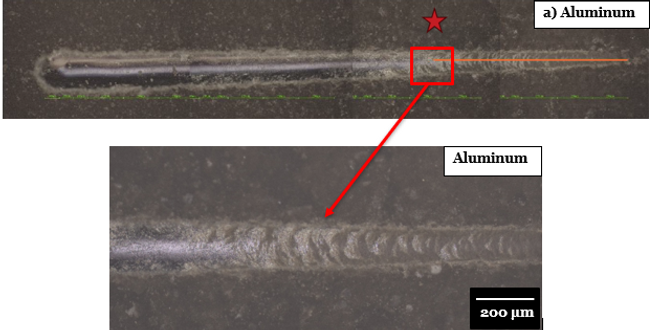
10- Resistance to Mechanical Damage — Scratch Testing
Hardness alone is not sufficient for a protective coating; the layer must also remain cohesive and strongly bonded to the substrate under mechanical loading. Scratch testing was used to evaluate the onset of coating cracking, cohesive damage, and eventual interfacial failure.
On aluminum, increasing load produced progressive cohesive cracking followed by coating spallation and substrate exposure, allowing the critical loads for cohesive and adhesive failure to be identified.
This is much stronger than just captioning the figures, because now the story becomes:
protective coating requirement → why the test was needed → test result → what we learned.
And when you add Figure 13 for steel, that will make the scratch section especially strong because it gives the direct contrast: aluminum shows failure progression, while the steel-supported coating showed no Lc1/Lc2 failure up to the maximum applied load of 25 N. That comparison is probably one of the best mechanical-performance visuals in the whole page.

11- Key Findings
Dry Aerosol Deposition successfully produced dense, well-adhered aluminosilicate coatings on substrates with widely different mechanical properties. Substrate hardness strongly influenced particle anchoring, film development, and final mechanical performance, with stainless steel producing the hardest and most mechanically robust coatings. Films on steel reached approximately 5.9 GPa hardness, 25 MPa pull-off strength, and showed no adhesive failure up to the maximum 25 N scratch load. These results demonstrate the potential of natural aluminosilicate as a cost-effective feedstock for protective ceramic coatings.
12- Publication
Karimian, A., & Fuierer, P. (2026). Substrate-dependent hardness and adhesion of nano-grained aluminosilicate films by dry aerosol deposition. Academia Nano: Science, Materials, Technology, 3(1). https://doi.org/10.20935/AcadNano8182