
Calcium-Doped Barium Hexaferrite for Acetone Gas Sensing
This research investigates how calcium substitution modifies the structure, microstructure, magnetic behavior, and gas-sensing performance of barium hexaferrite. Ba₁₋ₓCaₓFe₁₂O₁₉ compositions were synthesized by sol–gel auto-combustion and evaluated to identify the relationship between composition and acetone-sensing response.
Research Status: Done
1- Why This Research Matters ?
Gas sensing relies on materials whose electrical response changes through interaction with the surrounding atmosphere.
Ferrite-based oxides offer a compositionally tunable platform in which cation substitution can modify structure, conductivity, and sensing behavior. This study explored whether partial substitution of Ba²⁺ with Ca²⁺ could improve the acetone-sensing response of barium hexaferrite.
3- Material Synthesis
Sol–Gel Synthesis

Ba₁₋ₓCaₓFe₁₂O₁₉ powders with controlled calcium substitution were synthesized using a sol–gel auto-combustion route. Following gel formation and self-combustion, the powders were calcined at 950°C for 4.5 hours to develop the targeted hexaferrite phases.
2- Research Question
How does calcium substitution influence the structure, microstructure, magnetic properties, and acetone-sensing response of barium hexaferrite?
Ba₁₋ₓCaₓFe₁₂O₁₉ | x = 0, 0.2, 0.4, 1
4- Phase Evolution
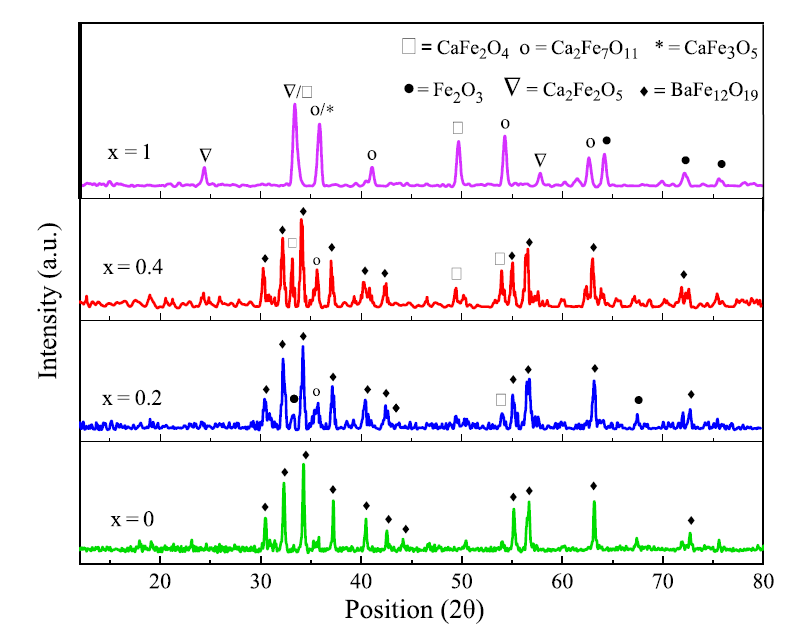
XRD analysis was used to determine how Ca substitution affected phase formation and crystal structure. Increasing calcium content altered the lattice parameters and reduced crystallite size, while higher substitution levels promoted secondary calcium- and iron-containing phases rather than maintaining a single dominant barium-hexaferrite structure.
5- Microstructural Evolution
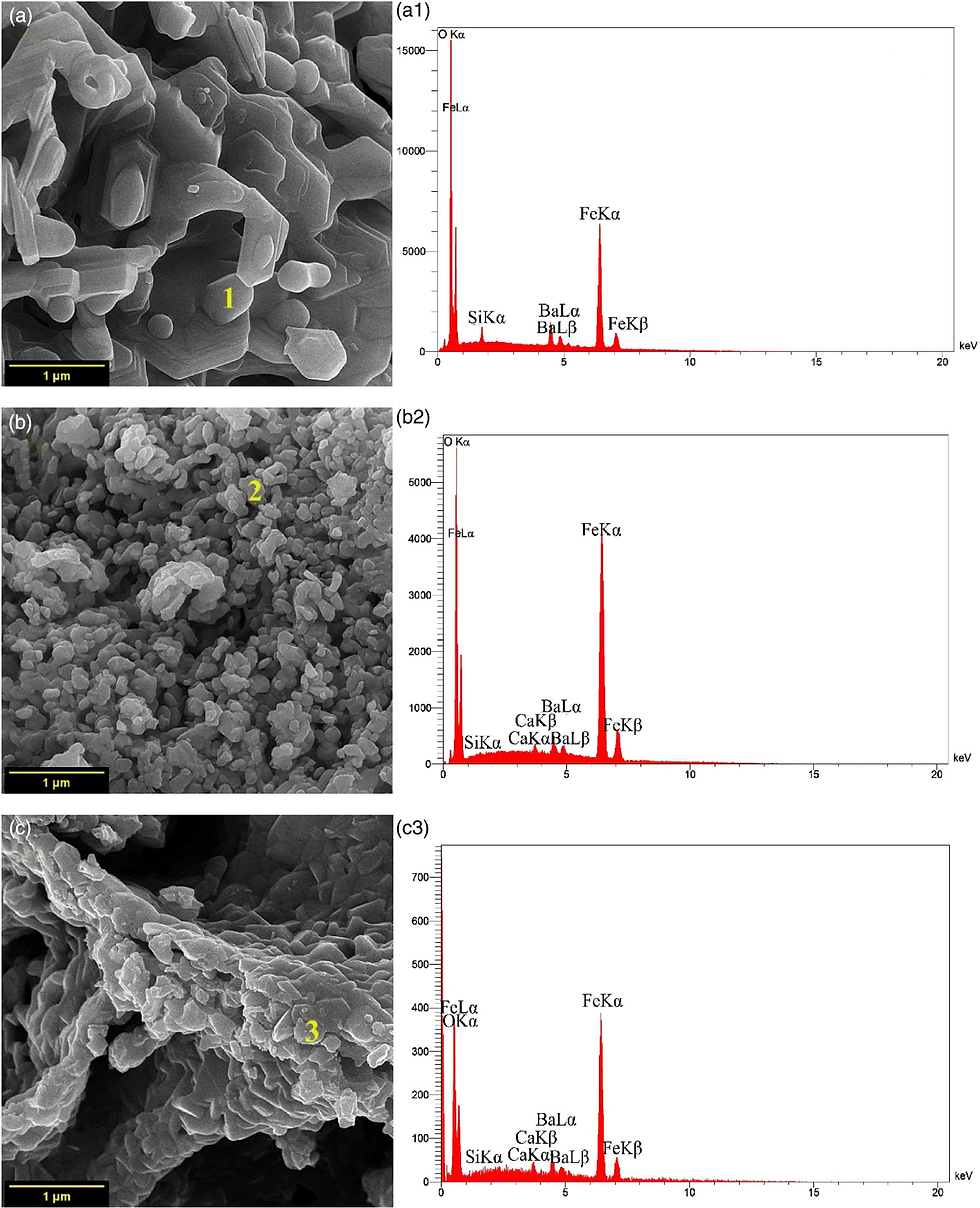
XRD analysis was used to determine how Ca substitution affected phase formation and crystal structure. Increasing calcium content altered the lattice parameters and reduced crystallite size, while higher substitution levels promoted secondary calcium- and iron-containing phases rather than maintaining a single dominant barium-hexaferrite structure.
6- Magnetic Properties
VSM measurements demonstrated a strong composition dependence of the magnetic response. While the x = 0 and x = 0.2 compositions retained substantial magnetization, increasing calcium substitution to x = 0.4 produced a pronounced reduction in saturation magnetization, consistent with increasing structural heterogeneity and the formation of nonmagnetic secondary phases

7- Sensor Testing
The synthesized materials were processed into sensing elements and evaluated in a controlled gas-testing chamber. Electrical resistance was monitored during exposure to acetone–argon mixtures at different concentrations and operating temperatures, allowing composition, temperature, and gas concentration to be linked directly to sensor response.


7- Gas-Sensing Mechanism
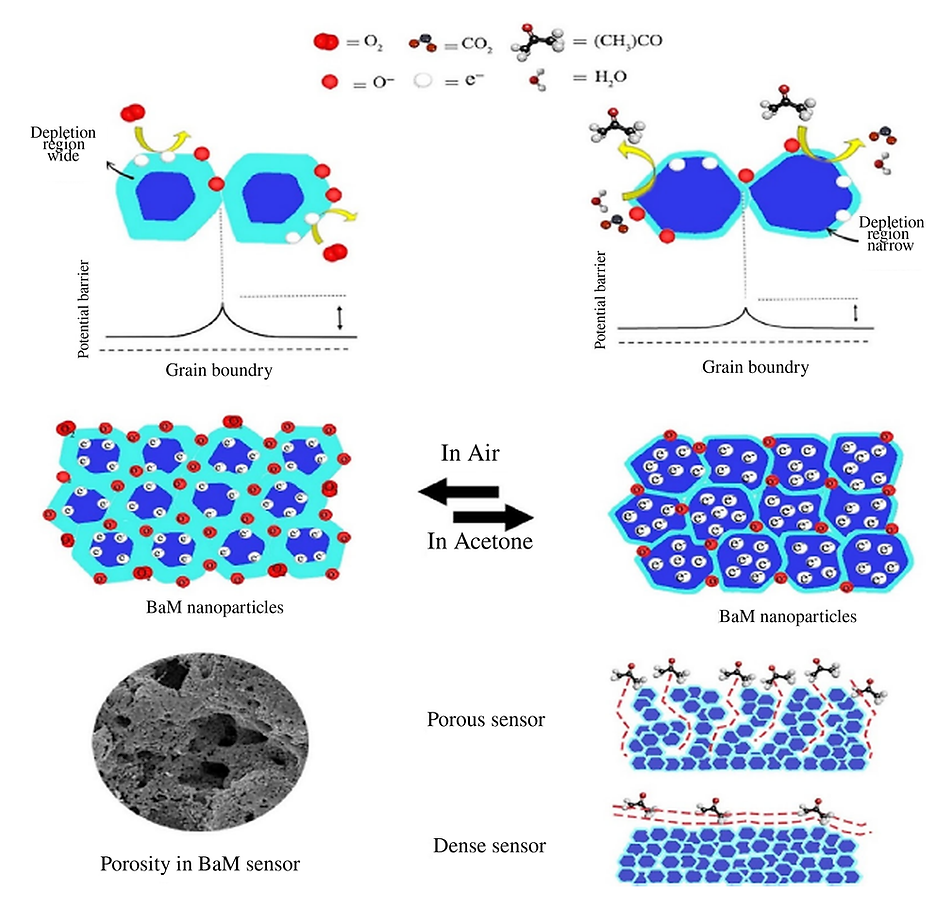
The sensing response originates from surface reactions between adsorbed oxygen species and acetone molecules. These interactions alter the charge-carrier population at the material surface, producing a measurable change in electrical resistance during gas exposure and recovery.
8- Acetone-Sensing Performance
Gas-sensing measurements revealed a strong dependence on calcium content. Among the compositions studied, Ba₀.₈Ca₀.₂Fe₁₂O₁₉ produced the strongest acetone response, reaching a sensitivity of 0.57 at 900 ppm and 300°C. Increasing calcium content further to x = 0.4 eliminated the measurable sensing response under the tested conditions, demonstrating that moderate rather than maximum substitution produced the most favorable behavior.

9- Key Findings
The results demonstrate that calcium substitution does more than change chemical composition: it modifies phase formation, crystallite size, particle morphology, magnetic behavior, and ultimately gas-sensing performance. A moderate substitution level, x = 0.2, provided the most favorable combination for acetone detection.