
Computational Modeling & Simulation
How does nozzle geometry influence gas flow, particle transport, and impact behavior during Dry Aerosol Deposition?
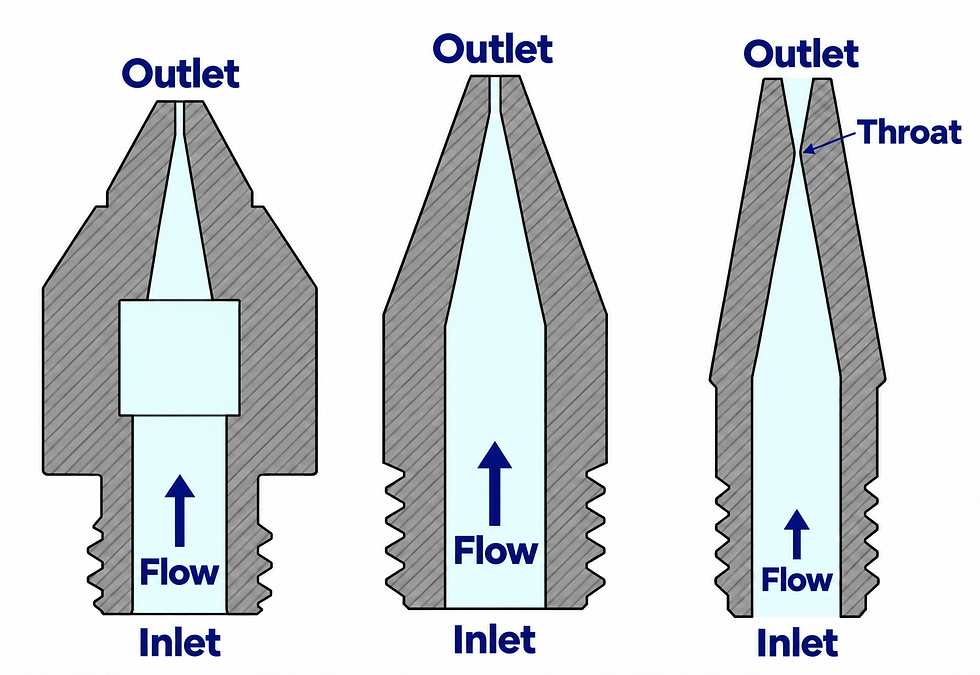
In dry aerosol deposition, nozzle geometry controls how the carrier gas expands and accelerates before reaching the substrate. This directly influences particle trajectories, acceleration, focusing, and ultimately the conditions under which particles impact the surface. Computational modeling is used to understand these relationships before moving to nozzle fabrication and experimental testing.
Modeling Approach
Dry aerosol deposition relies on particles reaching the substrate under conditions that promote impact, fragmentation, anchoring, and subsequent coating build-up. A baseline slit nozzle had already produced successful ceramic deposits; however, the same nozzle and operating conditions may not provide equally effective deposition for powders with different particle densities, size distributions, morphologies, or for harder substrate materials.
Starting from the Baseline Nozzle
The modeling work therefore began with the existing baseline nozzle as a reference geometry. Rather than changing the deposition system blindly, the first objective was to understand how particles behave as they travel through different nozzle geometries and approach the substrate.

Why Particle Transport Matters
Coating formation is influenced by several interconnected powder and process characteristics, including particle size, size distribution, morphology, density, and impact velocity. Changes in nozzle geometry can alter gas expansion and particle acceleration, which in turn affect particle trajectories, focusing, drag forces, and the velocity reached before impact.
Understanding these interactions is particularly important when sufficient particle impact energy is required to establish a stable anchoring layer and support continued coating build-up.

Modeling the Gas–Particle Interaction
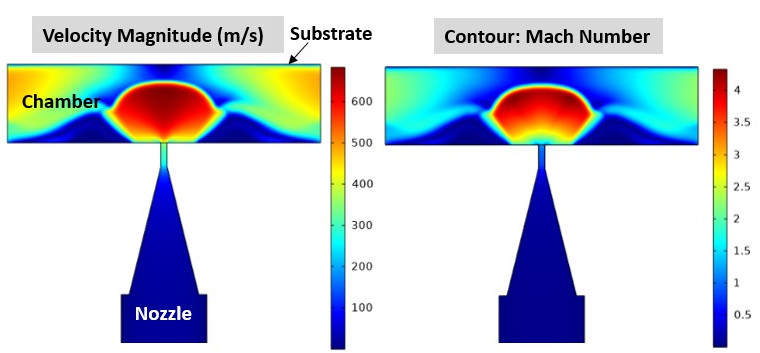
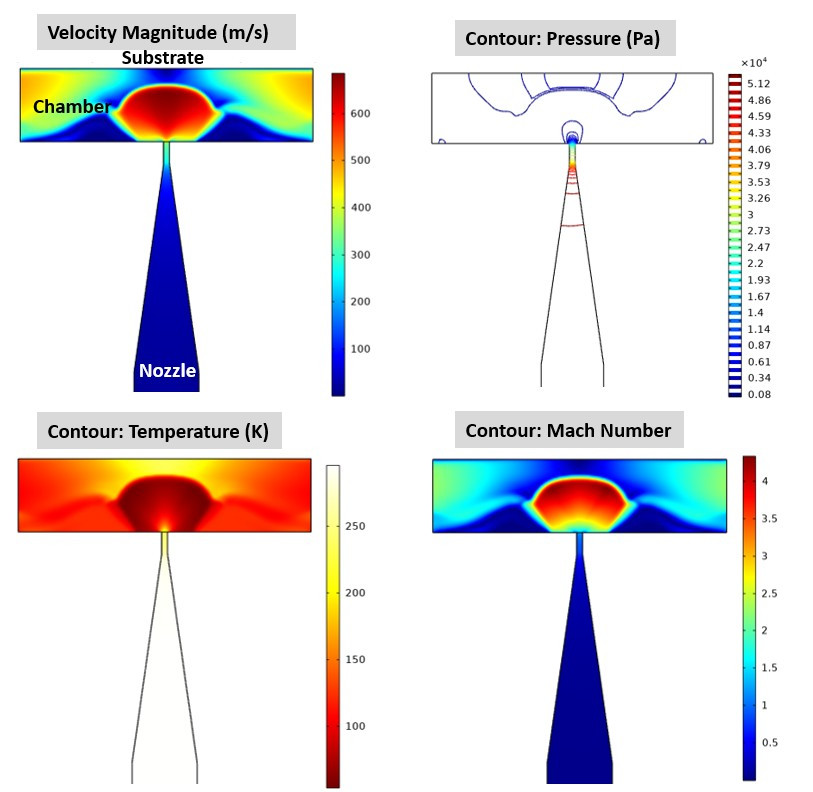
COMSOL Multiphysics is used to couple compressible gas-flow simulation with particle transport. Different nozzle geometries are evaluated under equivalent operating conditions so that the influence of geometry itself can be investigated.
The simulations are used to examine:
-
Gas velocity, pressure, and Mach-number evolution
-
Particle trajectories and focusing
-
Particle acceleration and velocity
-
Drag forces acting along the particle path
-
Particle behavior near the substrate

Using Experimental Conditions to Guide Nozzle Design
The modeling is connected directly to the experimental deposition process. Powder characteristics and the operating window identified through DOE-based deposition studies—including carrier-gas conditions, pressure differential between the aerosol generator and deposition chamber (ΔP), and feeder vibration—are used as the basis for evaluating nozzle behavior.
Rather than searching for a universally optimal nozzle, the objective is to develop a geometry that is better matched to the specific powder–process–substrate combination.
From Simulation to a More Robust Deposition Process
The final goal is to use computational modeling as a design tool to identify nozzle geometries that promote more controlled particle delivery and favorable impact conditions. Selected designs can then be fabricated and experimentally evaluated to determine whether the predicted transport behavior translates into more uniform coating formation, improved build-up, and robust deposited layers, by testing thickness, adhesion , density and Hardness and scratch resistance of coatings.
Simulation → Nozzle Design → Fabrication → Deposition → Coating Validation